Conseils · · 5 min de lecture
How to Learn French in Cameroon: A Practical Guide for Anglophones
You studied French at school, yet meetings in Douala or Yaoundé still leave you lost. Here is a realistic way to learn French in Cameroon, step by step.

If you grew up in Bamenda, Buea, Kumba or Limbe, you probably studied French at school for several years. Many English-speaking Cameroonians still find that this is not enough once they move to Douala or Yaoundé for work or university. Meetings run fast, administrative letters use a formal style, and people switch between French, Pidgin and local languages without warning. The good news is that you live in a country where French is everywhere, which makes it one of the best places to learn it.
Why learn French in Cameroon
French is one of the two official languages of Cameroon, and it is the language of daily life in most of the country. A good level of French opens doors in public administration, in national companies and in many regional organisations. It also makes life simpler: dealing with a landlord, a hospital, a bank or a school is easier when you understand every detail.
Living here also gives you free practice. Radio, television, newspapers, markets and taxis all offer French you can listen to every day. The challenge is to turn this exposure into steady progress.
Know your starting level
Before choosing a method, find out where you stand. Many anglophones understand written French quite well but struggle to speak, or the other way round. Levels are described on the CEFR scale, from A1 (beginner) to C2 (mastery). Our article on language levels A1 to C2 explains each one in detail (it is written in French, which makes it good reading practice).
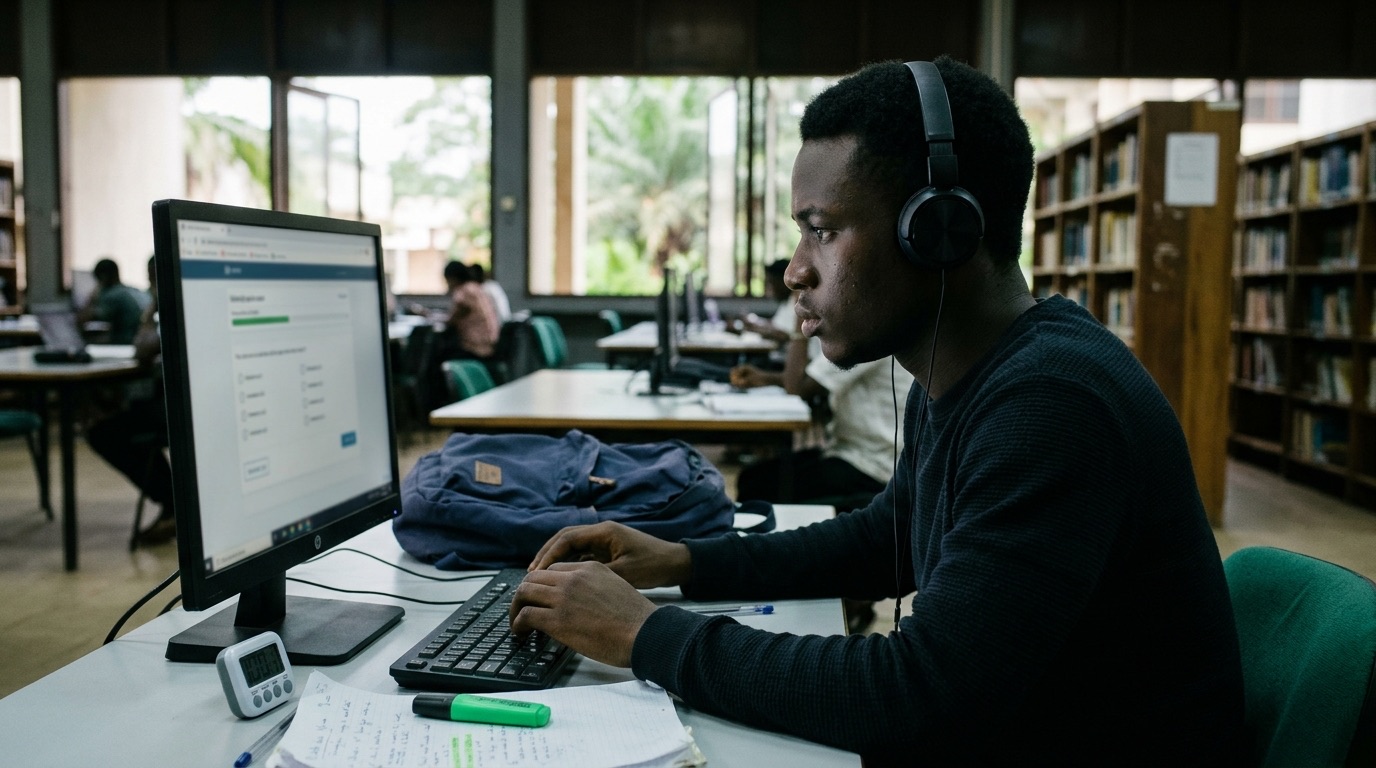
The quickest way to know your level is the free placement test on NERDS Academy. It takes about 5 minutes and tells you which level to start with.
How much time to spend on French each day
Regular short sessions work better than long ones once a week. Aim for 30 to 45 minutes a day, five or six days a week. Here is a simple routine:
| Day | What to do | Time |
|---|---|---|
| Monday | One lesson at your level, with its worksheet | 40 min |
| Tuesday | Listen to a French radio programme and summarise it aloud | 30 min |
| Wednesday | Speaking practice with an AI voice or a francophone friend | 30 min |
| Thursday | Review the week’s vocabulary and verb forms | 20 min |
| Friday | Live class or a real conversation at work | 45 min to 1 h |
| Saturday | Read a short article or a page of a novel in French | 30 min |
That is around four hours a week, which most working adults can manage.
Focus on speaking French early
Many learners wait until their grammar feels perfect before they speak. That moment rarely comes. Start speaking with the words you already have.
Listen and repeat
Pick short recordings that match your level. Listen once for the general idea, a second time for useful expressions, and a third time while repeating each sentence right after the speaker. This technique, called shadowing, trains your ear and your mouth together, and it is very effective for French pronunciation.
Practise without pressure, then with people
Describe what you are doing while you cook, rehearse a phone call before you make it, or record yourself for one minute and listen back. When you feel ready, move on to real conversations. At NERDS Academy you can practise speaking with an AI voice on your own, then join live classes in small groups of 3 to 6 people on Google Meet with a NERDS teacher who corrects you.
The main difficulties for English speakers
Some parts of French are hard for almost every English speaker. Knowing them in advance saves time.
Gender of nouns
Every French noun is masculine or feminine: « le bureau », « la réunion ». Learn each new noun with its article, never alone. Over time you will notice patterns, such as nouns ending in « -tion » which are usually feminine.
Pronunciation and silent letters
Many final letters are silent: « petit », « ils parlent ». Nasal sounds (« pain », « bon », « blanc ») also take practice. Listening and repeating every day is the only real solution here.
« Tu » and « vous »
French has two ways to say « you ». Use « vous » with people you do not know, with older people and in professional settings. Use « tu » with friends and family, or when someone invites you to. In Cameroonian offices, « vous » is the safe choice.
False friends
Some words look like English but mean something else. « Actuellement » means « currently », « une librairie » is a bookshop, and « assister à une réunion » means to attend a meeting, not to help.
Learn the French you actually need
Make a list of the situations where French matters most to you: meetings, emails, customers, exams, administrative paperwork. Then learn the expressions that come up again and again in those situations. A nurse, an accountant and a law student do not need the same vocabulary first.
Learn phrases rather than single words: « prendre rendez-vous », « envoyer un rappel », « remplir un formulaire ». You can reuse them as they are.
Stay consistent over several months
Motivation always drops after the first weeks. These habits help:
- study at the same time every day;
- keep a simple log of each session;
- set a concrete goal, such as following a full meeting in French;
- learn with others, because a group session is an appointment you will not skip;
- take a placement test again every two or three months to see your progress.
If you want to know how many months to plan for your goal, read our article on how long it takes to move up a level, which gives the usual estimates in guided learning hours.
French exams you may need
If you need an official certificate, the main French exams are the TCF, the DELF and the DALF. Check the requirements of your school or employer, and always confirm the details with the official exam provider.
Where to start
NERDS Academy offers French courses from A1 to C2, with 8 lessons per level, downloadable worksheets, AI voice practice and live small group classes. The A1 level is free. You can see every level in the course catalogue. The first step is simply to take the free placement test and find out which level suits you today.
- learn French
- Cameroon
- anglophones
- speaking
- CEFR